Tavex uses cookies to improve your user experience. By continuing to use our site without changing your settings, you agree to receive cookies from Tavex’s website. Read more about our cookie policy
Please select what cookies you allow us to use
Cookies are small files of letters and digits downloaded and saved on your computer or another device (for instance, a mobile phone, a tablet) and saved in your browser while you visit a website. They can be used to track the pages you visit on the website, save the information you enter or remember your preferences such as language settings as long as you’re browsing the website.
Cookie usage
Necessary
| Cookie name | Cookie description | Cookie duration |
|---|---|---|
| tavex_cookie_consent | Stores cookie consent options selected | 60 weeks |
| tavex_customer | Tavex customer ID | 30 days |
| wp-wpml_current_language | Stores selected language | 1 day |
| AWSALB | AWS ALB sticky session cookie | 6 days |
| AWSALBCORS | AWS ALB sticky session cookie | 6 days |
| NO_CACHE | Used to disable page caching | 1 day |
| PHPSESSID | Identifier for PHP session | Session |
| latest_news | Helps to keep notifications relevant by storing the latest news shown | 29 days |
| latest_news_flash | Helps to keep notifications relevant by storing the latest news shown | 29 days |
| tavex_recently_viewed_products | List of recently viewed products | 1 day |
| tavex_compare_amount | Number of items in product comparison view | 1 day |
Preference
| Cookie name | Cookie description | Cookie duration |
|---|---|---|
| chart-widget-tab-*-*-* | Remembers last chart options (i.e currency, time period, etc) | 29 days |
| archive_layout | Stores selected product layout on category pages | 1 day |
Marketing
| Cookie name | Cookie description | Cookie duration |
|---|---|---|
| cartstack.com-* | Used for tracking abandoned shopping carts | 1 year |
| _omappvp | Used by OptinMonster for determining new vs. returning visitors. Expires in 11 years | 11 years |
| _omappvs | Used by OptinMonster for determining when a new visitor becomes a returning visitor | Session |
| om* | Used by OptinMonster to track interactions with campaigns | Persistent |
Statistic
| Cookie name | Cookie description | Cookie duration |
|---|---|---|
| _ga | Used to distinguish users | 2 years |
| _gid | Used to distinguish users | 24 hours |
| _ga_* | Used to persist session state | 2 years |
| _gac_* | Contains campaign related information | 90 days |
| _gat_gtag_* | Used to throttle request rate | 1 minute |
| _fbc | Facebook advertisement cookie | 2 years |
| _fbp | Facebook cookie for distinguishing unique users | 2 years |

Gold Price Forecast for 2026: What Could Push Prices Higher?
Published by Karl Martin Karus in category Articles on 09.01.2026
Gold price (XAU-SEK)
41226,40 SEK/oz
- 317,00 SEK
Silver price (XAG-SEK)
603,50 SEK/oz
- 8,64 SEK

Innehållsförteckning / Table of Contents
Gold has regained its role as a strategic asset. As we look toward 2026, the key question is not relevance—but how high gold prices could realistically go.
Gold Price Outlook for 2026
In a world still shaped by debt, geopolitical uncertainty, and fragile monetary policy, gold continues to attract long-term interest. Despite competition from equities, AI, and digital assets, gold remains a cornerstone of portfolio protection.
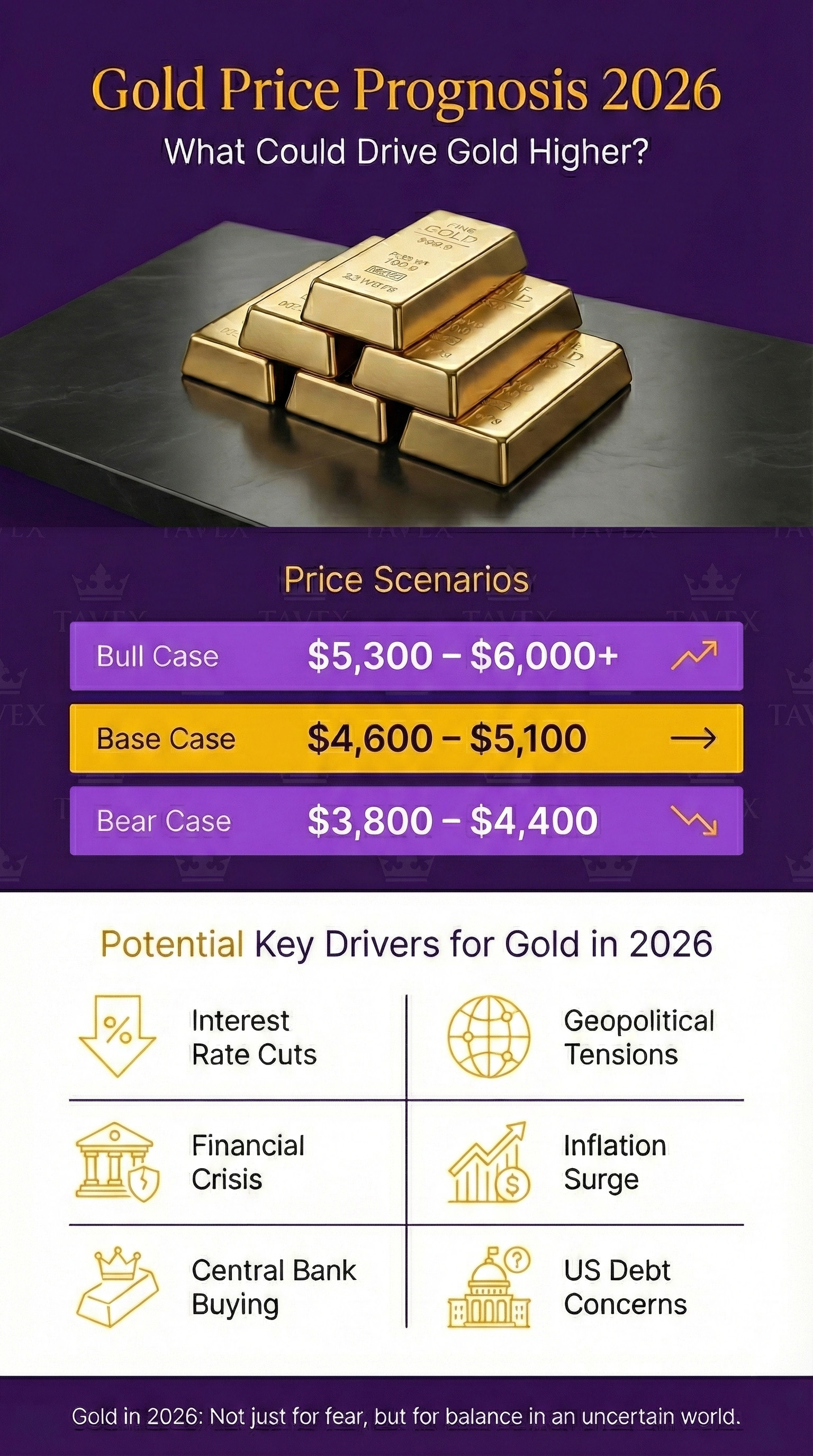
Under a base-case scenario, gold prices are expected to trade between $4,600 and $5,100 per ounce, with a strong possibility of ending 2026 closer to $4,900–$5,200. This outlook assumes gradually declining interest rates, steady central bank demand, and periodic geopolitical tensions that support safe-haven assets.
Several major financial institutions broadly align with this range, pointing to structural demand rather than short-term speculation as the main driver of higher prices.
A Bullish Scenario: When Gold Moves Fast
In a more aggressive scenario, gold could reach $5,300–$6,000 or higher, often through sharp price spikes rather than a slow, steady climb. These moves typically occur when financial stress and policy responses happen at the same time.
Gold historically reacts strongest when uncertainty rises and confidence in traditional assets weakens quickly. In such environments, capital tends to move rapidly into assets perceived as stable and independent of financial systems.
A Bearish Scenario: Possible, but Less Likely
A lower-price outcome for 2026 would place gold in the $3,800–$4,400 range. This would require persistently high real interest rates, a strong U.S. dollar, and a meaningful slowdown in central bank gold purchases.
At present, this scenario appears less probable. Markets are not confidently pricing in a combination of low inflation and strong, sustained economic growth.
Global Developments That Could Push Gold Higher
Several well-established global factors could support higher gold prices in 2026:
- Faster or deeper interest rate cuts than expected
- Financial stress in banking, credit markets, or commercial real estate
- Continued diversification into gold by central banks
- Escalating geopolitical tensions or trade disruptions
- A return of inflation alongside slowing economic growth
- Rising concerns over government debt and fiscal stability
Gold does not need a global crisis to perform well—only a convergence of a few of these forces.
A Realistic Price Range for 2026
Taking all factors into account, a balanced outlook places gold within a $4,500–$5,300 range for most of 2026. The most likely center of gravity remains around $4,900–$5,100, with upside potential if major global events unfold.
Short-term volatility should be expected, but the broader trend continues to favor long-term strength.

Final Thoughts: Gold’s Role Going Forward
Gold’s importance in 2026 is not driven by fear alone. It reflects a growing need for stability, trust, and balance in an increasingly complex global system.
For many investors, gold is no longer just a hedge. It is once again becoming a core strategic asset in long-term portfolio construction.
Gold price (XAU-SEK)
41226,40 SEK/oz
- 317,00 SEK
Silver price (XAG-SEK)
603,50 SEK/oz
- 8,64 SEK
Recommended articles


You might also like to read


Contact
Tavex AB Reg.nr.: 556671-1189 Smålandsgatan 9, 111 46 Stockholm, Sweden
E-mail: tavex@tavex.se
Tel. 08-678 20 30
Comments