Tavex uses cookies to improve your user experience. By continuing to use our site without changing your settings, you agree to receive cookies from Tavex’s website. Read more about our cookie policy
Please select what cookies you allow us to use
Cookies are small files of letters and digits downloaded and saved on your computer or another device (for instance, a mobile phone, a tablet) and saved in your browser while you visit a website. They can be used to track the pages you visit on the website, save the information you enter or remember your preferences such as language settings as long as you’re browsing the website.
Cookie usage
Necessary
| Cookie name | Cookie description | Cookie duration |
|---|---|---|
| tavex_cookie_consent | Stores cookie consent options selected | 60 weeks |
| tavex_customer | Tavex customer ID | 30 days |
| wp-wpml_current_language | Stores selected language | 1 day |
| AWSALB | AWS ALB sticky session cookie | 6 days |
| AWSALBCORS | AWS ALB sticky session cookie | 6 days |
| NO_CACHE | Used to disable page caching | 1 day |
| PHPSESSID | Identifier for PHP session | Session |
| latest_news | Helps to keep notifications relevant by storing the latest news shown | 29 days |
| latest_news_flash | Helps to keep notifications relevant by storing the latest news shown | 29 days |
| tavex_recently_viewed_products | List of recently viewed products | 1 day |
| tavex_compare_amount | Number of items in product comparison view | 1 day |
Preference
| Cookie name | Cookie description | Cookie duration |
|---|---|---|
| chart-widget-tab-*-*-* | Remembers last chart options (i.e currency, time period, etc) | 29 days |
| archive_layout | Stores selected product layout on category pages | 1 day |
Marketing
| Cookie name | Cookie description | Cookie duration |
|---|---|---|
| cartstack.com-* | Used for tracking abandoned shopping carts | 1 year |
| _omappvp | Used by OptinMonster for determining new vs. returning visitors. Expires in 11 years | 11 years |
| _omappvs | Used by OptinMonster for determining when a new visitor becomes a returning visitor | Session |
| om* | Used by OptinMonster to track interactions with campaigns | Persistent |
Statistic
| Cookie name | Cookie description | Cookie duration |
|---|---|---|
| _ga | Used to distinguish users | 2 years |
| _gid | Used to distinguish users | 24 hours |
| _ga_* | Used to persist session state | 2 years |
| _gac_* | Contains campaign related information | 90 days |
| _gat_gtag_* | Used to throttle request rate | 1 minute |
| _fbc | Facebook advertisement cookie | 2 years |
| _fbp | Facebook cookie for distinguishing unique users | 2 years |

After debt comes gold? How interest rates affect the gold price
Published by Mattias Söderström in category Articles on 28.09.2026
Gold price (XAU-SEK)
41094,90 SEK/oz
- 574,60 SEK
Silver price (XAG-SEK)
598,21 SEK/oz
- 15,52 SEK

Innehållsförteckning / Table of Contents
Interest rates are rising and US national debt has passed 40 trillion dollars. But what does this mean for gold, and why are more and more people talking about the debt?
Interest rates are rising – almost everywhere
Autumn 2026 is defined by one thing in the financial markets: rising interest rates.
On 16 September, the US Federal Reserve raised its policy rate by a quarter of a percentage point to a range of 3.75–4 percent. It was the first increase since 2023, and the Fed expects another hike later this year.
Market rates have also risen sharply. The yield on the 10-year US Treasury reached 5.23 percent, its highest level since 2007.
In Europe, the ECB raised its deposit rate to 2.5 percent on 10 September. It was the second hike this year, and the ECB points to the war in the Middle East as a driver of higher inflation.
Here in Sweden, the Riksbank left its policy rate unchanged at 1.75 percent. However, the Riksbank believes the rate will need to rise more than previously expected, and that the increases are expected to begin this year. The next monetary policy announcement is due on 4 November 2026.
Why higher interest rates tend to weigh on gold
Gold pays no interest. When rates rise, interest-bearing investments become more attractive, so gold can lose some of its appeal in the short term.
This has been visible this year. The gold price reached record levels above 5,000 dollars per ounce at the start of the year but has since fallen back by as much as around 18 percent.
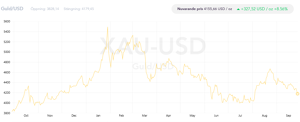
But interest rates are only part of the picture. If you look at the bigger picture, there is a larger issue that many analysts believe could affect gold in the longer term: debt.
US national debt at a record high
US national debt has grown at a pace that is hard to grasp. Here are some of the figures worrying the market:
- The debt passed 40 trillion dollars on 18 August and is more than twice as large as in 2017
- The US currently pays around 1.1 trillion dollars a year in interest on its debt, slightly more than it spends on defence
- The budget deficit for 2026 is expected to land at around 1.9 trillion dollars
- The Congressional Budget Office (CBO) expects interest costs to rise to 2.1 trillion dollars a year by 2036 if nothing changes
This means that an ever larger share of the US federal budget goes to interest instead of other things.
A Catch-22 for central banks
This is where a dilemma arises. Central banks raise interest rates to bring down inflation, but for a state with record debt, every rate hike becomes more and more expensive.
Cutting spending would be one solution, but it is politically difficult, not least ahead of the US midterm elections in November. At the same time, the Reason Foundation points out that the CBO’s debt forecast was made before the war with Iran began, which is expected to increase deficits further.
Efforts to keep long-term rates down have also had limited effect. The market considers Treasury Secretary Scott Bessent’s buybacks of government bonds to have had little effect.
After debt comes gold?
The question many are asking is how the debt will be handled if neither spending cuts nor higher interest rates are politically possible. One scenario being discussed is that the central bank eventually starts printing new money again, known as quantitative easing. This means the central bank buys government bonds with newly created money.
The more money that is created, the less each dollar is worth. Gold, on the other hand, cannot be printed, which is why it has long been seen as a counterweight when confidence in paper currencies wavers.
The world’s central banks are also continuing to buy gold. According to the World Gold Council, they bought a net 288.9 tonnes in the second quarter of 2026, the strongest second quarter on record.
Buy a gold bar at a great price today!

Short term and long term
No one can predict where the gold price will be in a week or a year. In the short term, rising interest rates and a strong dollar may continue to cause fluctuations, both up and down.
That is why many see gold as part of long-term, diversified savings rather than a way to make quick money. The idea is to own an asset that does not depend on interest rates or on how governments manage their debt.
Would you like to learn more about how physical gold could fit into your savings? At Tavex, you will find gold bars and gold coins in a range of sizes, and we are happy to help you find a format that suits you.
Gold price (XAU-SEK)
41094,90 SEK/oz
- 574,60 SEK
Silver price (XAG-SEK)
598,21 SEK/oz
- 15,52 SEK
Recommended articles


You might also like to read


Contact
Tavex AB Reg.nr.: 556671-1189 Smålandsgatan 9, 111 46 Stockholm, Sweden
E-mail: tavex@tavex.se
Tel. 08-678 20 30
Comments