Tavex uses cookies to improve your user experience. By continuing to use our site without changing your settings, you agree to receive cookies from Tavex’s website. Read more about our cookie policy
Please select what cookies you allow us to use
Cookies are small files of letters and digits downloaded and saved on your computer or another device (for instance, a mobile phone, a tablet) and saved in your browser while you visit a website. They can be used to track the pages you visit on the website, save the information you enter or remember your preferences such as language settings as long as you’re browsing the website.
Cookie usage
Necessary
| Cookie name | Cookie description | Cookie duration |
|---|---|---|
| tavex_cookie_consent | Stores cookie consent options selected | 60 weeks |
| tavex_customer | Tavex customer ID | 30 days |
| wp-wpml_current_language | Stores selected language | 1 day |
| AWSALB | AWS ALB sticky session cookie | 6 days |
| AWSALBCORS | AWS ALB sticky session cookie | 6 days |
| NO_CACHE | Used to disable page caching | 1 day |
| PHPSESSID | Identifier for PHP session | Session |
| latest_news | Helps to keep notifications relevant by storing the latest news shown | 29 days |
| latest_news_flash | Helps to keep notifications relevant by storing the latest news shown | 29 days |
| tavex_recently_viewed_products | List of recently viewed products | 1 day |
| tavex_compare_amount | Number of items in product comparison view | 1 day |
Preference
| Cookie name | Cookie description | Cookie duration |
|---|---|---|
| chart-widget-tab-*-*-* | Remembers last chart options (i.e currency, time period, etc) | 29 days |
| archive_layout | Stores selected product layout on category pages | 1 day |
Marketing
| Cookie name | Cookie description | Cookie duration |
|---|---|---|
| cartstack.com-* | Used for tracking abandoned shopping carts | 1 year |
| _omappvp | Used by OptinMonster for determining new vs. returning visitors. Expires in 11 years | 11 years |
| _omappvs | Used by OptinMonster for determining when a new visitor becomes a returning visitor | Session |
| om* | Used by OptinMonster to track interactions with campaigns | Persistent |
Statistic
| Cookie name | Cookie description | Cookie duration |
|---|---|---|
| _ga | Used to distinguish users | 2 years |
| _gid | Used to distinguish users | 24 hours |
| _ga_* | Used to persist session state | 2 years |
| _gac_* | Contains campaign related information | 90 days |
| _gat_gtag_* | Used to throttle request rate | 1 minute |
| _fbc | Facebook advertisement cookie | 2 years |
| _fbp | Facebook cookie for distinguishing unique users | 2 years |

Why Gold Is Becoming More Important in Modern Portfolios
Published by Karl Martin Karus in category Articles on 25.08.2026
Gold price (XAU-SEK)
41071,50 SEK/oz
- 550,60 SEK
Silver price (XAG-SEK)
597,41 SEK/oz
- 16,87 SEK

Innehållsförteckning / Table of Contents
Gold is playing a bigger role in modern portfolios as investors rethink the traditional stock-and-bond mix. Here is why the shift matters.
For decades, one of the best-known approaches to investing has been the traditional 60/40 portfolio: 60% equities for growth and 40% bonds for stability.
But higher inflation, changing interest rates and periods when stocks and bonds have fallen together have encouraged investors to look more closely at other ways to diversify.
One asset receiving increasing attention is gold.
Gold’s Role in Portfolios Has Changed
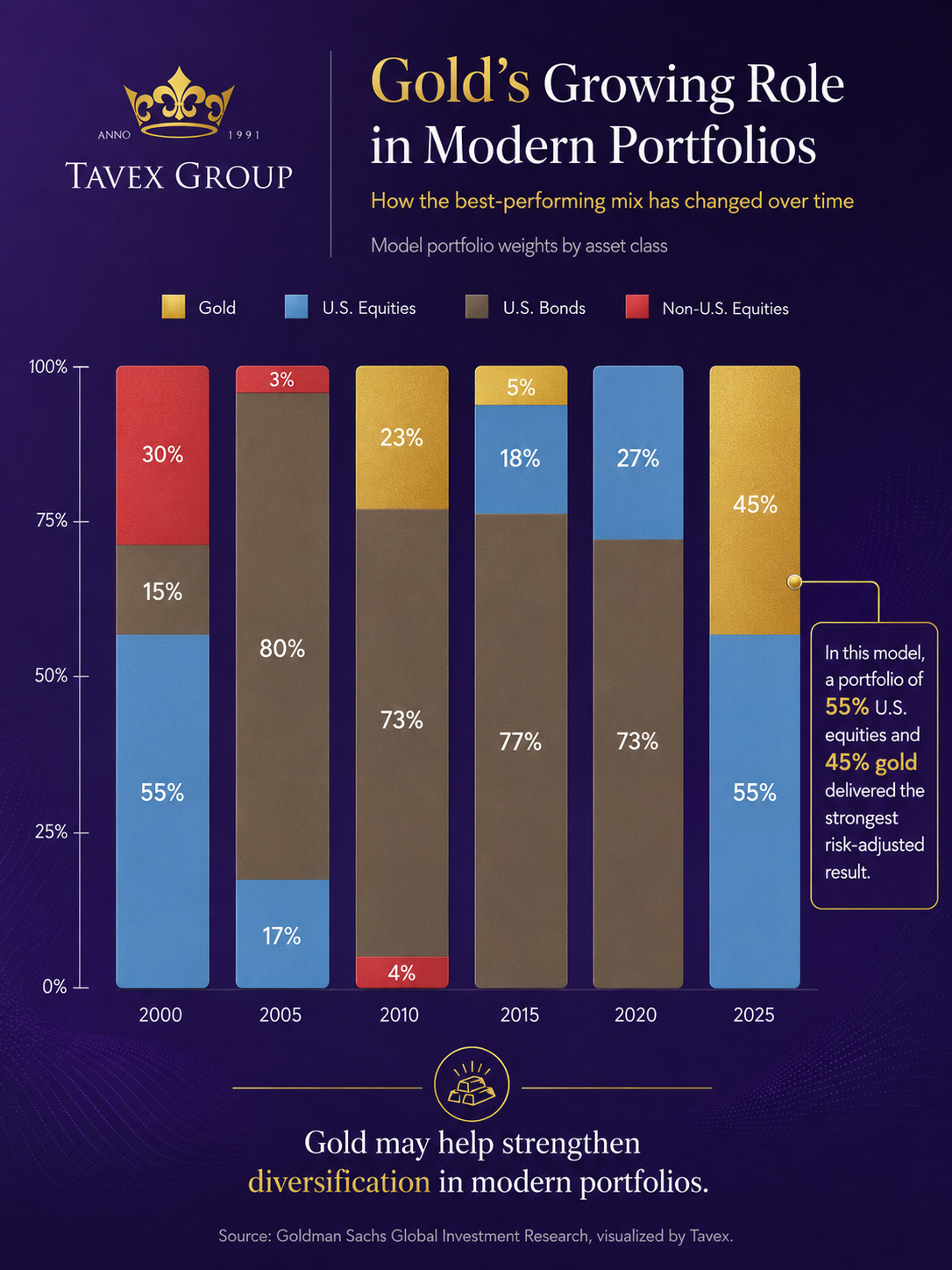
Recent research from Goldman Sachs illustrates just how much the theoretical optimal portfolio has changed during different market environments.
Data highlighted by Visual Capitalist shows the optimal asset weights of a World Portfolio at different points since 2000:
| Year | U.S. equities | Non-U.S. equities | U.S. bonds | Gold |
|---|---|---|---|---|
| 2000 | 55% | 30% | 15% | 0% |
| 2005 | 17% | 3% | 80% | 0% |
| 2010 | 0% | 4% | 73% | 23% |
| 2015 | 18% | 0% | 77% | 5% |
| 2020 | 27% | 0% | 73% | 0% |
| 2025 | 55% | 0% | 0% | 45% |
In the 2025 model, the optimal mix shifted to 55% U.S. equities and 45% gold, compared with portfolios dominated by bonds in several earlier periods.
This does not mean that 45% gold is an appropriate allocation for every investor. The figures show which mix would have provided the best risk-adjusted result within this particular model and historical period.
Why Is the Traditional 60/40 Portfolio Being Questioned?
Bonds have traditionally been used to balance the higher volatility of equities. However, recent market conditions have shown that stocks and bonds do not always move in opposite directions.
Several factors have increased interest in alternative sources of diversification:
- higher and less predictable inflation;
- changing interest-rate expectations;
- periods when stocks and bonds decline at the same time;
- greater geopolitical and economic uncertainty.
When traditional asset classes become more closely correlated, investors may look for assets that behave differently during periods of stress.
Why Gold Can Improve Diversification
Gold behaves differently from both equities and bonds.
It does not generate company earnings like a stock or pay interest like a bond. Instead, its value is influenced by a broad mix of investment demand, central-bank demand, jewellery consumption, interest rates, currencies and economic uncertainty.
This different set of drivers can make gold useful as a portfolio diversifier.
World Gold Council research shows that gold has historically tended to become more negatively correlated with equities during major market sell-offs. In other words, its diversification characteristics can become particularly useful when financial markets are under pressure.
Gold Is More Than a Crisis Asset
Gold is often associated with financial crises, but its role is not limited to periods of market stress.
It is a global and highly liquid asset with no direct credit risk. Unlike a bond, physical gold does not depend on a company or government being able to repay its obligations.
Gold also has several different sources of demand. It is purchased by private investors, central banks and the jewellery industry, while smaller amounts are also used in technology.
These different sources of demand help explain why gold can behave differently from traditional financial assets over longer periods.
Does This Mean Investors Should Hold 45% Gold?
No single gold allocation is suitable for every portfolio.
The 45% figure from the Goldman Sachs data is particularly interesting because it shows how strongly the optimal historical mix shifted after the COVID-19 period. However, it should not be interpreted as a general recommendation to place almost half of a portfolio in gold.
More broadly, World Gold Council research has tested smaller allocations ranging from approximately 2.5% to 10%.
Its 2026 analysis found that adding gold to hypothetical diversified portfolios over the previous 20 years could improve risk-adjusted returns and reduce portfolio drawdowns.
The appropriate allocation ultimately depends on factors such as investment horizon, existing assets, risk tolerance and the purpose gold is intended to serve in the portfolio.
Why Gold’s Importance Is Growing
The wider trend is more important than any single percentage.
Gold has increasingly moved from being viewed only as a temporary safe haven toward being considered a strategic part of a diversified portfolio.
Goldman Sachs has also highlighted that modern portfolios may need more than the traditional division between stocks and bonds, particularly when investors face both inflation risk and high exposure to equity markets.
At the same time, central banks around the world have been buying gold at historically high levels, further strengthening its role as a global reserve and investment asset.
What Does This Mean for Investors?
The traditional stock-and-bond portfolio is unlikely to disappear. Equities remain an important source of long-term growth, while bonds can still provide income and stability.
However, recent market conditions have shown why diversification across different types of assets matters.
Gold can offer something different: an asset with no direct credit risk, a global market and historically low correlation with many traditional investments.
The growing role of gold does not mean replacing stocks and bonds entirely. Instead, it highlights why more investors are considering gold as a permanent part of a broader long-term portfolio.
Sources: Goldman Sachs Global Investment Research, World Gold Council and Visual Capitalist. Historical portfolio optimisation is based on past data and does not represent a guaranteed future return or individual investment recommendation.
Gold price (XAU-SEK)
41071,50 SEK/oz
- 550,60 SEK
Silver price (XAG-SEK)
597,41 SEK/oz
- 16,87 SEK
Recommended articles


You might also like to read


Contact
Tavex AB Reg.nr.: 556671-1189 Smålandsgatan 9, 111 46 Stockholm, Sweden
E-mail: tavex@tavex.se
Tel. 08-678 20 30
Comments