Tavex uses cookies to improve your user experience. By continuing to use our site without changing your settings, you agree to receive cookies from Tavex’s website. Read more about our cookie policy
Please select what cookies you allow us to use
Cookies are small files of letters and digits downloaded and saved on your computer or another device (for instance, a mobile phone, a tablet) and saved in your browser while you visit a website. They can be used to track the pages you visit on the website, save the information you enter or remember your preferences such as language settings as long as you’re browsing the website.
Cookie usage
Necessary
| Cookie name | Cookie description | Cookie duration |
|---|---|---|
| tavex_cookie_consent | Stores cookie consent options selected | 60 weeks |
| tavex_customer | Tavex customer ID | 30 days |
| wp-wpml_current_language | Stores selected language | 1 day |
| AWSALB | AWS ALB sticky session cookie | 6 days |
| AWSALBCORS | AWS ALB sticky session cookie | 6 days |
| NO_CACHE | Used to disable page caching | 1 day |
| PHPSESSID | Identifier for PHP session | Session |
| latest_news | Helps to keep notifications relevant by storing the latest news shown | 29 days |
| latest_news_flash | Helps to keep notifications relevant by storing the latest news shown | 29 days |
| tavex_recently_viewed_products | List of recently viewed products | 1 day |
| tavex_compare_amount | Number of items in product comparison view | 1 day |
Preference
| Cookie name | Cookie description | Cookie duration |
|---|---|---|
| chart-widget-tab-*-*-* | Remembers last chart options (i.e currency, time period, etc) | 29 days |
| archive_layout | Stores selected product layout on category pages | 1 day |
Marketing
| Cookie name | Cookie description | Cookie duration |
|---|---|---|
| cartstack.com-* | Used for tracking abandoned shopping carts | 1 year |
| _omappvp | Used by OptinMonster for determining new vs. returning visitors. Expires in 11 years | 11 years |
| _omappvs | Used by OptinMonster for determining when a new visitor becomes a returning visitor | Session |
| om* | Used by OptinMonster to track interactions with campaigns | Persistent |
Statistic
| Cookie name | Cookie description | Cookie duration |
|---|---|---|
| _ga | Used to distinguish users | 2 years |
| _gid | Used to distinguish users | 24 hours |
| _ga_* | Used to persist session state | 2 years |
| _gac_* | Contains campaign related information | 90 days |
| _gat_gtag_* | Used to throttle request rate | 1 minute |
| _fbc | Facebook advertisement cookie | 2 years |
| _fbp | Facebook cookie for distinguishing unique users | 2 years |

Which Countries Have the Largest Gold Reserves in 2026?
Published by Karl Martin Karus in category Articles on 25.08.2026
Gold price (XAU-SEK)
41071,50 SEK/oz
- 550,60 SEK
Silver price (XAG-SEK)
597,41 SEK/oz
- 16,87 SEK

Innehållsförteckning / Table of Contents
The US holds more gold than any other country, but central banks worldwide are still buying. See which countries lead the gold reserve ranking in 2026.
Gold has been used to preserve wealth for thousands of years, and it still plays an important role in the global financial system.
Central banks hold physical gold as part of their official reserves to diversify risk and strengthen financial stability.
So, which countries own the most gold today?
Countries With the Largest Gold Reserves
According to World Gold Council data and the latest available central-bank figures in 2026, the largest official gold reserves are:
| Rank | Country | Gold reserves |
|---|---|---|
| 1 | United States | 8,133.5 tonnes |
| 2 | Germany | 3,350.3 tonnes |
| 3 | Italy | 2,451.8 tonnes |
| 4 | France | 2,437.0 tonnes |
| 5 | China | Approx. 2,346 tonnes |
| 6 | Russia | Approx. 2,282 tonnes |
| 7 | Switzerland | 1,039.9 tonnes |
| 8 | India | Approx. 880.5 tonnes |
| 9 | Japan | 846.0 tonnes |
| 10 | Poland | Approx. 632 tonnes |
The figures may refer to slightly different reporting months because central banks publish their reserve statistics at different times.
The US Has the World’s Largest Gold Reserve
The United States is by far the world’s largest official holder of gold.
Its reserves total approximately 8,133.5 tonnes, more than twice as much as Germany in second place.
Most of this gold was accumulated decades ago, when gold played a much larger role in the international monetary system.
The US has therefore not needed to make major new purchases to maintain its leading position.
Germany Leads Europe
Germany holds approximately 3,350 tonnes of gold, giving it the largest national gold reserve in Europe and the second-largest in the world.
Italy follows with around 2,452 tonnes, while France owns approximately 2,437 tonnes.
This means that three European countries are among the four largest national gold holders globally.
China Continues to Buy Gold
China has become one of the most closely watched central-bank gold buyers.
By the end of June 2026, its officially reported reserves had reached approximately 2,346 tonnes, moving China ahead of Russia in the global ranking.
Despite its large gold holdings, gold still represents a relatively small part of China’s enormous total reserve portfolio.
This leaves China with considerable room to increase its gold allocation further, which is one reason its central-bank purchases receive so much attention.
Poland Is Climbing the Ranking
Poland has been one of the world’s most active central-bank gold buyers in recent years.
After adding around 102 tonnes during 2025, the National Bank of Poland continued buying in 2026.
By the end of June, Poland’s reserves had reached approximately 632 tonnes, placing the country among the world’s ten largest national gold holders.
Its rapid accumulation shows how the global gold reserve landscape is changing beyond the traditional large holders in the US and Western Europe.
Why Do Central Banks Hold Gold?
Modern currencies are no longer directly backed by gold, but central banks still consider it an important reserve asset.
Common reasons for holding gold include:
- diversifying national reserves;
- protecting against financial and geopolitical uncertainty;
- preserving value over the long term;
- reducing dependence on foreign currencies and other countries’ financial assets.
Gold is also different from bonds and many other financial assets because it does not depend on another institution’s ability to repay a debt.
For central banks managing reserves over decades, this can be an important advantage.
Central Banks Are Still Buying Gold
Central-bank demand for gold has remained unusually strong.
According to the World Gold Council, central banks accumulated roughly 1,000 tonnes of gold per year on average during the four years leading up to 2026.
Purchases continued during 2026, with countries including Poland, China, Uzbekistan and Kazakhstan increasing their holdings.
This suggests that gold is becoming a long-term part of reserve strategy for many central banks rather than simply a short-term response to inflation or market uncertainty.
How Much Gold Does Sweden Have?
Sweden is not among the world’s largest gold holders, but Sveriges Riksbank still owns a substantial reserve.
As of 30 April 2026, the Riksbank held 125.7 tonnes of gold, worth approximately SEK 172.6 billion at the time.
Sweden ranked around 35th globally.
The gold is not stored only in Sweden. Parts of the reserve are held in the United Kingdom, the United States, Canada and Switzerland.
A significant share is stored at the Bank of England in London, one of the world’s most important centres for gold trading.
Gold Reserves Can Be Measured in Two Ways
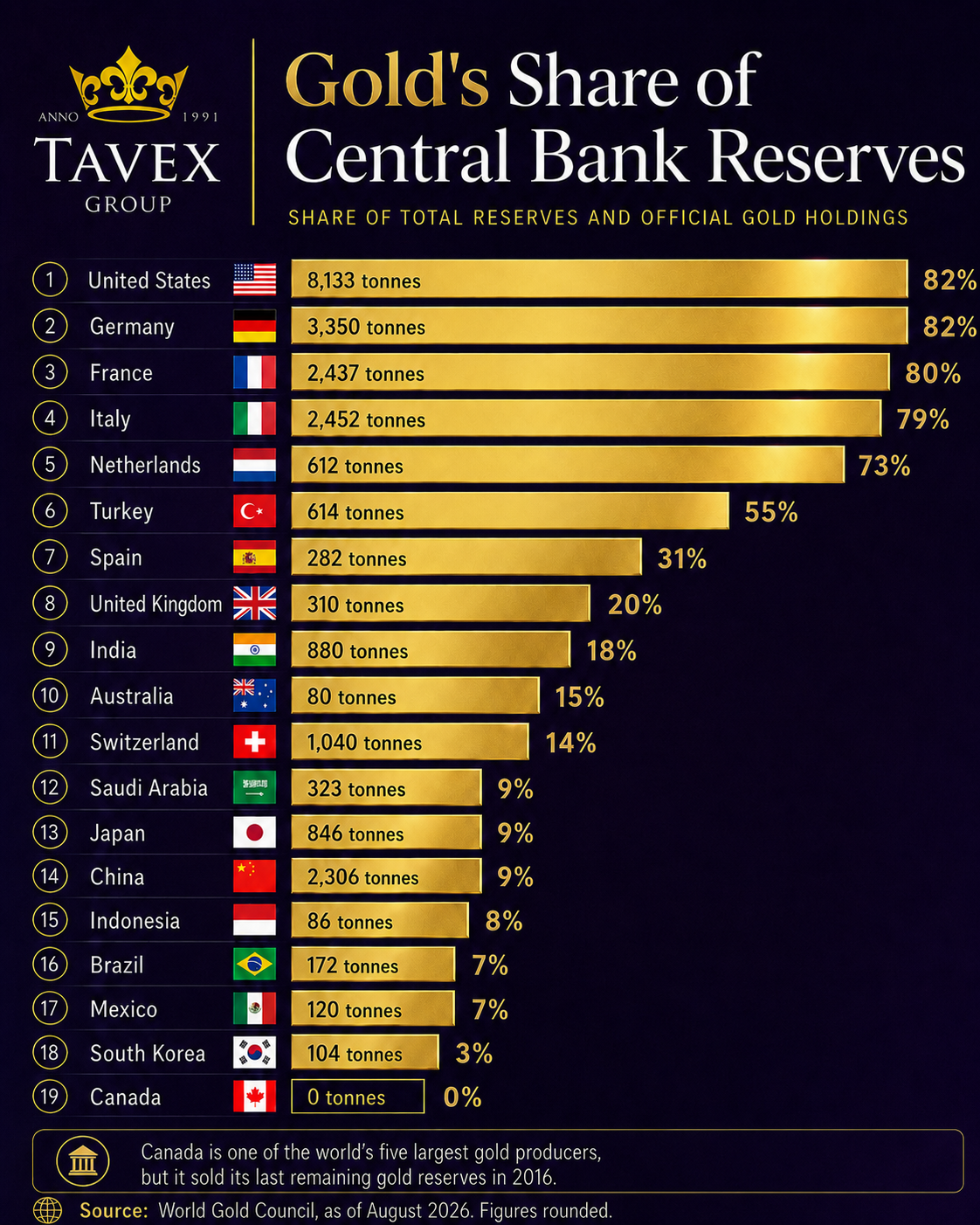
There is an important difference between how many tonnes of gold a country owns and how much of its total reserves are held in gold.
China, for example, owns more than 2,300 tonnes, but gold represents a relatively small percentage of its total reserves.
Countries such as the US, Germany, Italy and France hold a much larger share of their reserves in gold.
This is why rankings based on tonnes can look very different from rankings based on gold’s share of total reserves.
What Does This Mean for Investors?
Central banks and private investors have different objectives, so central-bank buying should not be treated as a direct investment recommendation.
However, continued purchases show that gold still has an important role in the global financial system.
Central banks value it for diversification, long-term value preservation and protection against economic and geopolitical risks.
More than 50 years after the end of the Bretton Woods system, physical gold remains one of the world’s most important reserve assets.
Sources: World Gold Council, IMF International Financial Statistics, Sveriges Riksbank and official central-bank reserve data.
Gold price (XAU-SEK)
41071,50 SEK/oz
- 550,60 SEK
Silver price (XAG-SEK)
597,41 SEK/oz
- 16,87 SEK
Recommended articles


You might also like to read


Contact
Tavex AB Reg.nr.: 556671-1189 Smålandsgatan 9, 111 46 Stockholm, Sweden
E-mail: tavex@tavex.se
Tel. 08-678 20 30
Comments