Tavex uses cookies to improve your user experience. By continuing to use our site without changing your settings, you agree to receive cookies from Tavex’s website. Read more about our cookie policy
Please select what cookies you allow us to use
Cookies are small files of letters and digits downloaded and saved on your computer or another device (for instance, a mobile phone, a tablet) and saved in your browser while you visit a website. They can be used to track the pages you visit on the website, save the information you enter or remember your preferences such as language settings as long as you’re browsing the website.
Cookie usage
Necessary
| Cookie name | Cookie description | Cookie duration |
|---|---|---|
| tavex_cookie_consent | Stores cookie consent options selected | 60 weeks |
| tavex_customer | Tavex customer ID | 30 days |
| wp-wpml_current_language | Stores selected language | 1 day |
| AWSALB | AWS ALB sticky session cookie | 6 days |
| AWSALBCORS | AWS ALB sticky session cookie | 6 days |
| NO_CACHE | Used to disable page caching | 1 day |
| PHPSESSID | Identifier for PHP session | Session |
| latest_news | Helps to keep notifications relevant by storing the latest news shown | 29 days |
| latest_news_flash | Helps to keep notifications relevant by storing the latest news shown | 29 days |
| tavex_recently_viewed_products | List of recently viewed products | 1 day |
| tavex_compare_amount | Number of items in product comparison view | 1 day |
Preference
| Cookie name | Cookie description | Cookie duration |
|---|---|---|
| chart-widget-tab-*-*-* | Remembers last chart options (i.e currency, time period, etc) | 29 days |
| archive_layout | Stores selected product layout on category pages | 1 day |
Marketing
| Cookie name | Cookie description | Cookie duration |
|---|---|---|
| cartstack.com-* | Used for tracking abandoned shopping carts | 1 year |
| _omappvp | Used by OptinMonster for determining new vs. returning visitors. Expires in 11 years | 11 years |
| _omappvs | Used by OptinMonster for determining when a new visitor becomes a returning visitor | Session |
| om* | Used by OptinMonster to track interactions with campaigns | Persistent |
Statistic
| Cookie name | Cookie description | Cookie duration |
|---|---|---|
| _ga | Used to distinguish users | 2 years |
| _gid | Used to distinguish users | 24 hours |
| _ga_* | Used to persist session state | 2 years |
| _gac_* | Contains campaign related information | 90 days |
| _gat_gtag_* | Used to throttle request rate | 1 minute |
| _fbc | Facebook advertisement cookie | 2 years |
| _fbp | Facebook cookie for distinguishing unique users | 2 years |

How Scammers Choose Their Victims Before They Call?
Published by Karl Martin Karus in category Articles on 01.09.2026
Gold price (XAU-SEK)
41071,50 SEK/oz
- 550,60 SEK
Silver price (XAG-SEK)
597,41 SEK/oz
- 16,87 SEK

Innehållsförteckning / Table of Contents
Phone scams are becoming more targeted. Police data shows that criminals often research victims in advance before making contact.
Phone Scams Are Becoming More Targeted
Telephone fraud is no longer just about criminals calling random numbers and hoping someone answers.
A police analysis from the Stockholm region suggests that fraudsters increasingly select their victims carefully before making contact. Around 5,000 reported telephone scams between January 2025 and March 2026 were examined as part of the analysis.
The results reveal a clear pattern: older people, particularly women, are significantly more likely to be targeted.
According to the police, the average victim was around 79 years old, while approximately 75% of the victims were women.
Maryam Zafaranlou, group leader at the fraud section of the Stockholm police region, says the findings indicate that telephone scams are not random. Instead, criminals systematically focus on elderly people and especially women.
Fraudsters Research Their Victims in Advance
Before making the first phone call, scammers may already know surprisingly much about the person they are contacting.
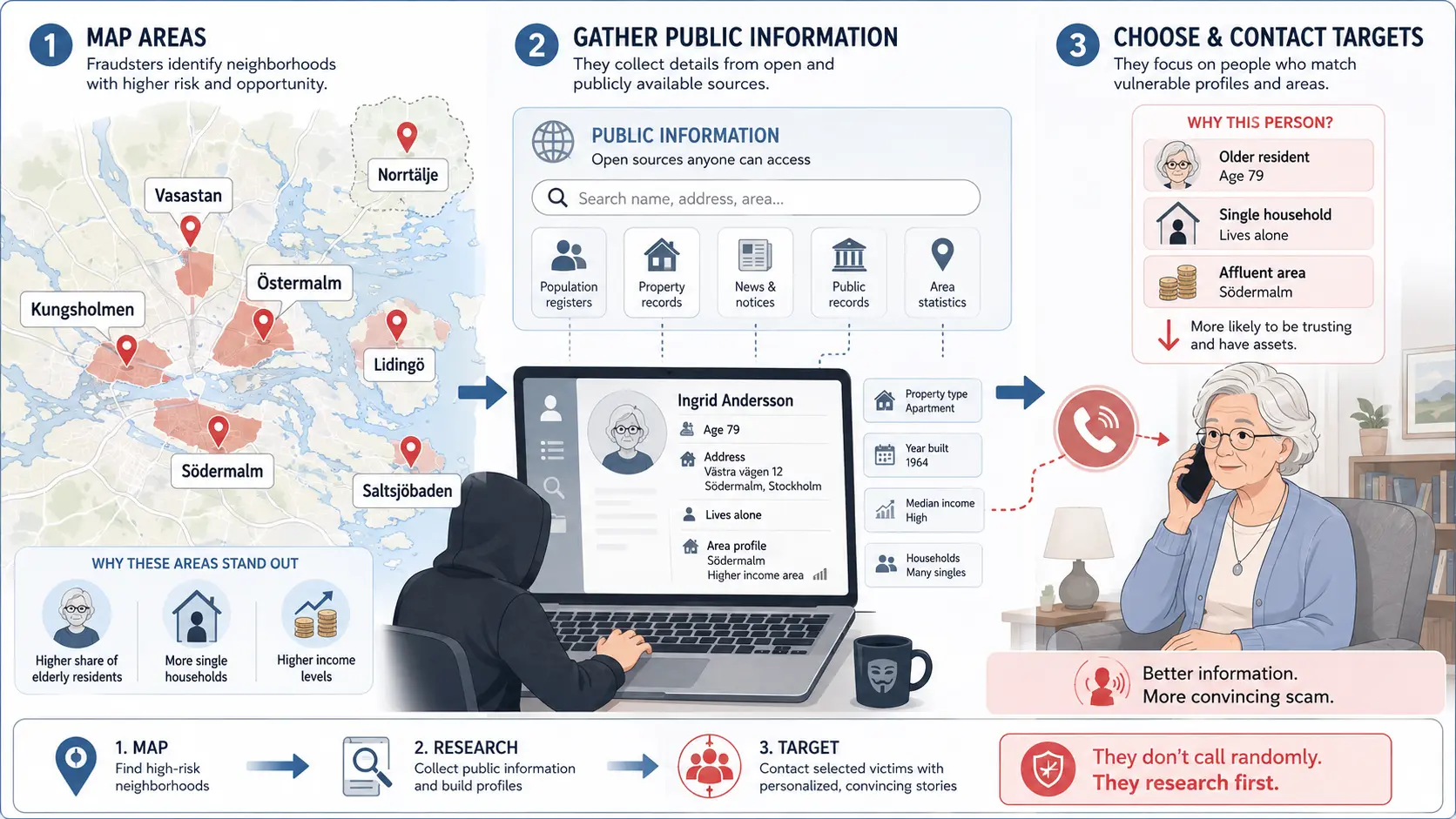
Police have identified several areas around Stockholm where telephone fraud appears more frequently. These include Östermalm, Kungsholmen, Vasastan and parts of Södermalm, as well as Lidingö, Saltsjöbaden and Norrtälje.
These areas often have several factors in common: relatively high incomes, many older residents and a large number of people living alone.
Handelsbanken has also observed similar behaviour. According to the bank, fraudsters may research potential victims beforehand to make their scams more convincing and improve their chances of success.
Public Information Can Help Scammers Find Targets
Much of the information criminals use may come from publicly available sources.
According to Criminal Inspector Björn Seeth at the Swedish Police National Fraud Center, scammers frequently use common online search and directory services to identify potential victims.
They may search services such as Eniro, Hitta.se and Ratsit to gather information about people living in a certain neighbourhood before deciding who to contact.
Publicly available information may reveal details such as:
- a person’s name and age;
- where the person lives;
- whether someone else is registered at the same address;
- information that can indicate whether the area is relatively affluent.
Individually, these details may appear harmless. Combined, however, they can help criminals build a clearer picture of a potential victim.
Some Phone Scams End With a Home Visit
The methods used by scammers are also becoming more sophisticated.
One increasingly worrying form of fraud is sometimes referred to as physical vishing. The scam usually begins with a telephone call but later continues with someone visiting the victim’s home.
The caller may claim to represent a bank, the police or another trusted organisation. The victim can then be told that their money, jewellery or other valuables are at risk and need to be “secured”.
A person may later arrive at the victim’s home to collect bank cards, jewellery, cash or other valuables.
Police in several Swedish regions have warned about this type of fraud. The general advice is clear: never allow an unknown person into your home simply because someone on the phone claims they represent a bank, authority or police organisation.
Fraud Losses Have Fallen but the Problem Remains
There are some encouraging signs.
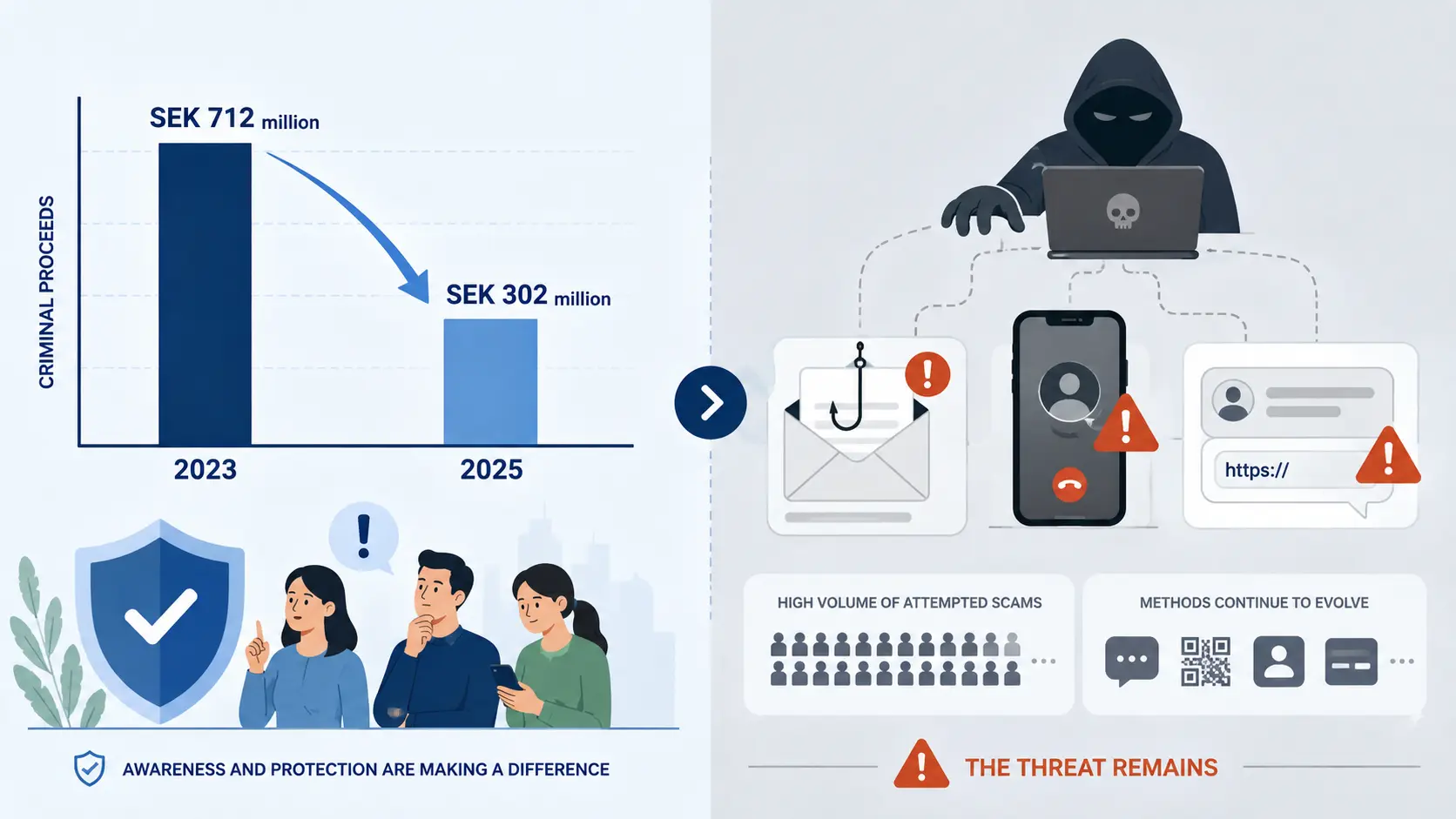
The total amount criminals earned through this type of fraud has fallen significantly in recent years. According to police figures, criminal proceeds declined from approximately SEK 712 million in 2023 to just under SEK 302 million in 2025.
Greater public awareness is believed to be one reason for the decline.
However, the overall number of attempted scams remains high, and criminals continue to change their methods. Phishing messages, fraudulent phone calls and other forms of social engineering remain widespread.
This means that even as individual fraud methods become better known, new variations can quickly appear.
New Rules Could Make Fraudulent Calls Harder
Sweden has also introduced measures aimed at making telephone fraud more difficult.
New legislation requires telephone operators to take stronger action against calls and messages suspected of being used for fraud.
Police hope these measures will make it harder for criminals to disguise fraudulent calls or reach large numbers of potential victims.
Technology alone, however, is unlikely to eliminate the problem completely.
Awareness remains one of the strongest forms of protection. Be especially cautious if someone unexpectedly contacts you and asks you to transfer money, identify yourself using BankID, provide card details or hand over valuables.
Legitimate banks, police officers and authorities will not unexpectedly send someone to your home to collect your jewellery, cash or bank cards.
If a call feels suspicious, end the conversation and independently contact the organisation the caller claims to represent.
If someone contacts you claiming to represent Tavex, use the official Tavex contact details to verify the request independently
Gold price (XAU-SEK)
41071,50 SEK/oz
- 550,60 SEK
Silver price (XAG-SEK)
597,41 SEK/oz
- 16,87 SEK
Recommended articles


You might also like to read


Contact
Tavex AB Reg.nr.: 556671-1189 Smålandsgatan 9, 111 46 Stockholm, Sweden
E-mail: tavex@tavex.se
Tel. 08-678 20 30

Comments