Tavex uses cookies to improve your user experience. By continuing to use our site without changing your settings, you agree to receive cookies from Tavex’s website. Read more about our cookie policy
Please select what cookies you allow us to use
Cookies are small files of letters and digits downloaded and saved on your computer or another device (for instance, a mobile phone, a tablet) and saved in your browser while you visit a website. They can be used to track the pages you visit on the website, save the information you enter or remember your preferences such as language settings as long as you’re browsing the website.
Cookie usage
Necessary
| Cookie name | Cookie description | Cookie duration |
|---|---|---|
| tavex_cookie_consent | Stores cookie consent options selected | 60 weeks |
| tavex_customer | Tavex customer ID | 30 days |
| wp-wpml_current_language | Stores selected language | 1 day |
| AWSALB | AWS ALB sticky session cookie | 6 days |
| AWSALBCORS | AWS ALB sticky session cookie | 6 days |
| NO_CACHE | Used to disable page caching | 1 day |
| PHPSESSID | Identifier for PHP session | Session |
| latest_news | Helps to keep notifications relevant by storing the latest news shown | 29 days |
| latest_news_flash | Helps to keep notifications relevant by storing the latest news shown | 29 days |
| tavex_recently_viewed_products | List of recently viewed products | 1 day |
| tavex_compare_amount | Number of items in product comparison view | 1 day |
Preference
| Cookie name | Cookie description | Cookie duration |
|---|---|---|
| chart-widget-tab-*-*-* | Remembers last chart options (i.e currency, time period, etc) | 29 days |
| archive_layout | Stores selected product layout on category pages | 1 day |
Marketing
| Cookie name | Cookie description | Cookie duration |
|---|---|---|
| cartstack.com-* | Used for tracking abandoned shopping carts | 1 year |
| _omappvp | Used by OptinMonster for determining new vs. returning visitors. Expires in 11 years | 11 years |
| _omappvs | Used by OptinMonster for determining when a new visitor becomes a returning visitor | Session |
| om* | Used by OptinMonster to track interactions with campaigns | Persistent |
Statistic
| Cookie name | Cookie description | Cookie duration |
|---|---|---|
| _ga | Used to distinguish users | 2 years |
| _gid | Used to distinguish users | 24 hours |
| _ga_* | Used to persist session state | 2 years |
| _gac_* | Contains campaign related information | 90 days |
| _gat_gtag_* | Used to throttle request rate | 1 minute |
| _fbc | Facebook advertisement cookie | 2 years |
| _fbp | Facebook cookie for distinguishing unique users | 2 years |

Gold Price Reaches Highest in Last Quarter: What's Next for Precious Metals?
Published by Karl Martin Karus in category Articles on 08.10.2024
Gold price (XAU-SEK)
40238,40 SEK/oz
+ 279,10 SEK
Silver price (XAG-SEK)
538,08 SEK/oz
+ 5,25 SEK

Innehållsförteckning / Table of Contents
Gold prices surged in the third quarter at the fastest pace in eight years, reaching fresh records in September. Is there still room for gold to rise in this uptrend, and what lies ahead in the coming years?
Gold’s Third Quarter Surge: A Record-Breaking Performance
In the third quarter of 2024, gold prices rose by 13.2%, closing September at $2,634.7 per ounce. This marked the biggest quarterly gain since the first quarter of 2016, when gold appreciated by 16.2%.
Gold increased by 5.2% in September alone, the most significant monthly gain since March.

(source: Tavid.ee)
Fed’s Rate Cut Fuels Gold’s Rise
Gold’s momentum in September was driven by the Federal Reserve’s decision to cut interest rates by 0.5 percentage points.
This was the first rate cut since 2020. Strong physical demand, central bank purchases, and the flow of Western institutional money into the market continue to support the gold market.
Long-Term Drivers: Deficits, Debt, and Geopolitical Tensions
Long-term factors also contribute to the uptrend, including significant budget deficits in the U.S. and other countries, skyrocketing interest payments on national debts, and escalating geopolitical tensions in the Middle East.
Gold Price Reaches All-Time High After Fed Decision
Although there were significant price fluctuations in the hours following the Fed’s decision on September 18, gold prices hit new records the following day. The peak was reached on September 26, closing at $2,672 per ounce. As of this writing, gold is trading at around $2,659.
Lowering interest rates generally reduces the actual yield on U.S. Treasury bonds, meaning investors receive lower interest returns. Since gold is a primary safe-haven asset alongside bonds, it becomes more attractive to investors when bond yields decline.
Next Fed Meeting and Market Expectations
The next Federal Reserve meeting to decide on interest rates is scheduled for November 7. Markets are confident that rates will be cut again, with a 69% probability for a 0.25 percentage point cut and a 31% chance of a 0.5 percentage point reduction.
Disclaimer: The forecasts and price levels mentioned below should not be taken as investment advice. For long-term investing, precise timing is less crucial, and much of the following is based on market sentiment and historical movements in the gold market over the past 20 years.
What’s Next for Gold Prices?
The rapid rise in gold prices after the Fed’s decision suggests that gold is nearing projected targets set earlier this year. Gold is expected to trade between $2,700 and $2,900 per ounce before the year ends, possibly exceeding $2,900 later this year or early next year.
Factors such as ongoing rate cuts, strong demand from central banks and the physical market, and rising geopolitical tensions in the Middle East indicate that a major price drop is unlikely in the near future.
The $3,000 level could be a strong resistance point for gold, as significant round numbers often serve as psychological barriers. For example:
- The $1,000 level was a resistance point for gold from March 2008 to October 2009
- The $2,000 level was a barrier from 2020 to 2023. During that period, gold approached $2,070 several times but stayed above $2,000 for only a few weeks.
The breakthrough came in March this year when gold decisively surpassed the $2,000 mark. Reaching the $3,000 level would represent an 85% increase from the 2022 low of $1,621 per ounce, almost doubling its value.
Gold’s Recent Surge and Historical Trends
Reviewing gold’s trends over the past 20 years, the rapid rise phase of the last uptrend (from November 2015 to August 2020) began in August 2018, with gold increasing by 79% in two years.
So far, gold has risen by 66% since the lows in September 2022.
In this decade, gold’s rapid rise phases usually last 1.5 to 3 years before a correction occurs. The exception was after the 2008 financial crisis when gold nearly tripled in value over three years, followed by a decline of over 45% that lasted more than four years.
However, a similar significant drop is unexpected, as the fundamentals supporting the gold market remain strong. The market appears to be entering a long-term uptrend, identical to the early 2000s or the 1970s.
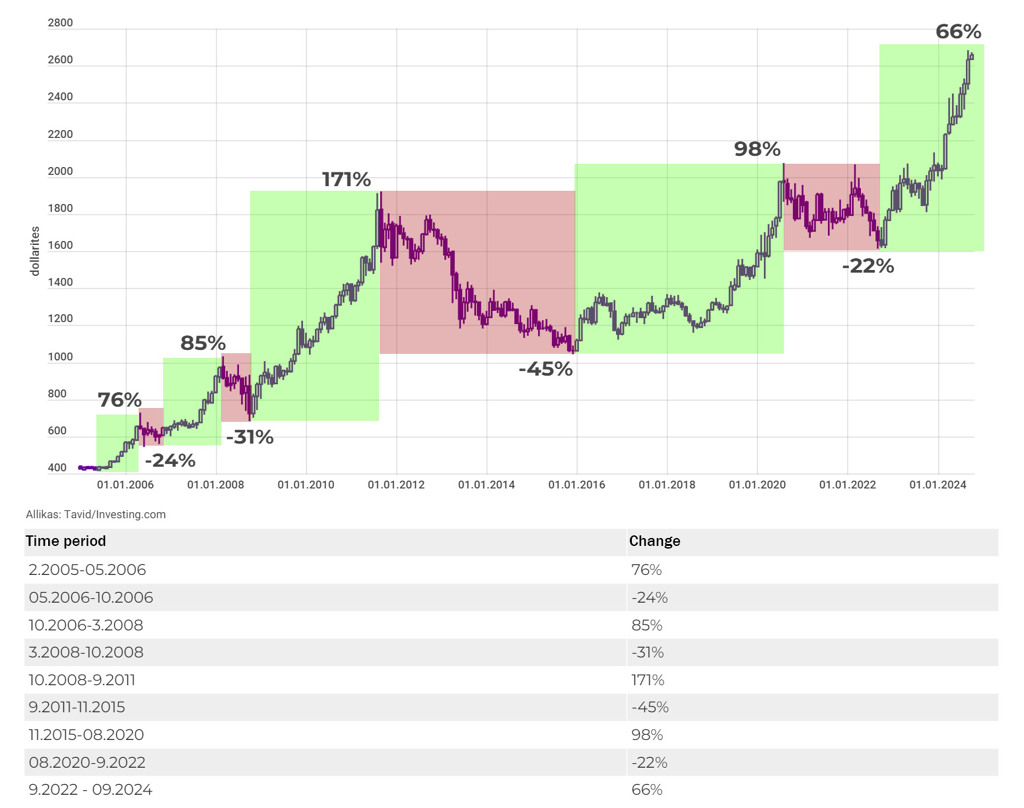
(source: Tavid.ee)
Correction Followed by an Even Faster Rise
Mait Kraun, Tavex Group analyst, expects gold to reach the $2,900-$3,000 range in this uptrend before a market correction occurs.
His base case scenario suggests that within the next 12 months, a recession in the U.S. is likely, which could lead to a temporary drop in gold prices, as is often the case during recessions. However, he anticipates only a modest 15-25% decline from the peak rather than a significant correction.
Kraun also notes that the crisis response will likely involve more money printing and increasing budget deficits. The U.S. and many other countries are already dealing with enormous budget deficits while interest payments on national debt continue to soar. At the same time, geopolitical tensions are rising, and a second wave of inflation appears likely, driven by underlying trends such as record debt levels and deglobalization.
After the next correction, Kraun predicts an even faster rise in gold prices. He compares the situation not to the post-financial crisis period but to the 1970s stagflation, which featured low economic growth alongside high inflation. He points out that between 1971 and early 1980, gold prices increased 24-fold.
Disclaimer: This article is for informational purposes only and is not intended as an investment analysis or recommendation to sell or buy commodities. Tavex is not responsible for any decisions made based on this information. Investing is associated with opportunities and risks, and the market value of commodities can both increase and decrease. Past or future yields on the commodities and financial ratios shown above do not represent a promise or an indication of future earnings.
Gold price (XAU-SEK)
40238,40 SEK/oz
+ 279,10 SEK
Silver price (XAG-SEK)
538,08 SEK/oz
+ 5,25 SEK
Recommended articles


You might also like to read


Contact
Tavex AB Reg.nr.: 556671-1189 Smålandsgatan 9, 111 46 Stockholm, Sweden
E-mail: tavex@tavex.se
Tel. 08-678 20 30
Comments