Tavex uses cookies to improve your user experience. By continuing to use our site without changing your settings, you agree to receive cookies from Tavex’s website. Read more about our cookie policy
Please select what cookies you allow us to use
Cookies are small files of letters and digits downloaded and saved on your computer or another device (for instance, a mobile phone, a tablet) and saved in your browser while you visit a website. They can be used to track the pages you visit on the website, save the information you enter or remember your preferences such as language settings as long as you’re browsing the website.
Cookie usage
Necessary
| Cookie name | Cookie description | Cookie duration |
|---|---|---|
| tavex_cookie_consent | Stores cookie consent options selected | 60 weeks |
| tavex_customer | Tavex customer ID | 30 days |
| wp-wpml_current_language | Stores selected language | 1 day |
| AWSALB | AWS ALB sticky session cookie | 6 days |
| AWSALBCORS | AWS ALB sticky session cookie | 6 days |
| NO_CACHE | Used to disable page caching | 1 day |
| PHPSESSID | Identifier for PHP session | Session |
| latest_news | Helps to keep notifications relevant by storing the latest news shown | 29 days |
| latest_news_flash | Helps to keep notifications relevant by storing the latest news shown | 29 days |
| tavex_recently_viewed_products | List of recently viewed products | 1 day |
| tavex_compare_amount | Number of items in product comparison view | 1 day |
Preference
| Cookie name | Cookie description | Cookie duration |
|---|---|---|
| chart-widget-tab-*-*-* | Remembers last chart options (i.e currency, time period, etc) | 29 days |
| archive_layout | Stores selected product layout on category pages | 1 day |
Marketing
| Cookie name | Cookie description | Cookie duration |
|---|---|---|
| cartstack.com-* | Used for tracking abandoned shopping carts | 1 year |
| _omappvp | Used by OptinMonster for determining new vs. returning visitors. Expires in 11 years | 11 years |
| _omappvs | Used by OptinMonster for determining when a new visitor becomes a returning visitor | Session |
| om* | Used by OptinMonster to track interactions with campaigns | Persistent |
Statistic
| Cookie name | Cookie description | Cookie duration |
|---|---|---|
| _ga | Used to distinguish users | 2 years |
| _gid | Used to distinguish users | 24 hours |
| _ga_* | Used to persist session state | 2 years |
| _gac_* | Contains campaign related information | 90 days |
| _gat_gtag_* | Used to throttle request rate | 1 minute |
| _fbc | Facebook advertisement cookie | 2 years |
| _fbp | Facebook cookie for distinguishing unique users | 2 years |

Inflation Drops to 1.3% – A Positive Sign for the Swedish Economy
Published by Karl Martin Karus in category Articles on 18.07.2024
Gold price (XAU-SEK)
40238,40 SEK/oz
+ 279,10 SEK
Silver price (XAG-SEK)
538,08 SEK/oz
+ 5,25 SEK

Innehållsförteckning / Table of Contents
Featured image: Photo by Pavel Keyzik on Unsplash
Quick reminders about inflation:
Inflation refers to the general increase in prices of goods and services in an economy over time. This means that as inflation rises, the purchasing power of money decreases; you can buy less with the same amount of money compared to before. For example, if inflation is 2%, something that cost $100 last year will cost $102 this year.
Sweden Sees Major Inflation Drop Below Central Bank’s Target in June 2024
In June 2024, Sweden’s inflation rate dropped significantly. The Consumer Price Index for fixed interest rates (CPIF) fell to 1.3%. This is the first time inflation is below the Swedish Central Bank’s target of 2% in three years. This change affects the Swedish economy, especially in terms of homeowners and market stability.
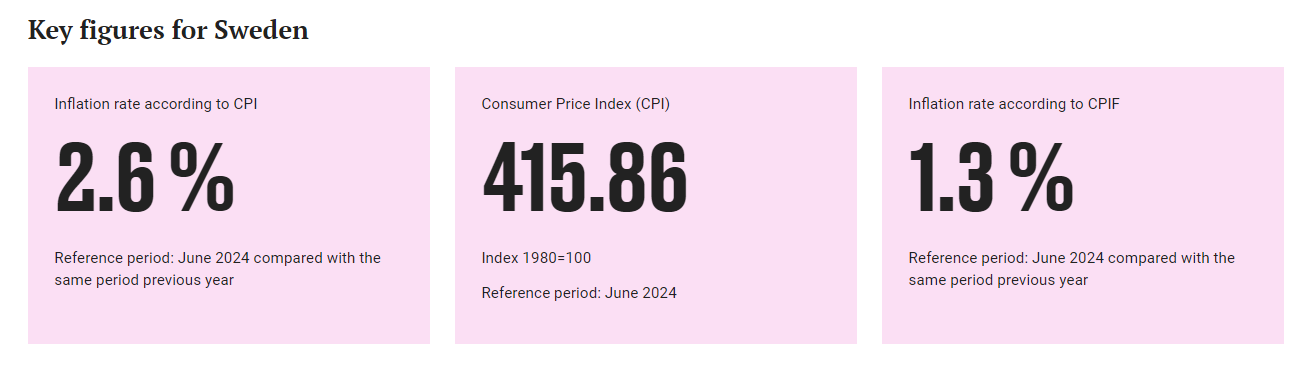 (Image screenshot from: scb.se)
Encouraging News for Homeowners
Kristina Lagerström, an economic reporter for SVT, pointed out that this is good news for homeowners with mortgages. The CPIF, which doesn’t include mortgage interest rate changes, dropped from 2.3% in May to 1.3% in June, significantly easing inflation pressures.
*CPIF measures how much prices for goods and services in Sweden are changing, but it doesn’t count changes in mortgage interest rates. This helps show real inflation without the ups and downs of mortgage rates.
Factors Contributing to the Decline
According to Statistics Sweden (SCB), several reasons contributed to the decrease in inflation in June:
- Seasonal Sales: Many stores had seasonal sales, leading to lower clothing prices.
- Hotel Stays: There were price reductions for hotel stays, making travel and accommodation cheaper.
- Recreational Activities: Prices for recreational activities, like sports and hobbies, went down.
- Cultural Services: Costs for cultural services, such as museum tickets and concerts, also decreased.
These price drops in different areas helped bring down the overall inflation rate for June.
What Does This Mean for Consumers?
Even though inflation has decreased, it doesn’t mean prices will drop immediately; they remain high. However, the significant drop in inflation indicates a stabilizing economy, which is a positive sign for future price trends.
Impact on Interest Rates and Loans
One immediate effect of the lower inflation rate is its potential impact on mortgage rates. The Swedish Central Bank might feel more confident in lowering interest rates, possibly as early as August, with further reductions in the fall. This would benefit those with variable-rate mortgages, potentially reducing their monthly payments.
 (Photo by Kelly Sikkema on Unsplash)
Future Risks and Economic Stability
While the current drop in inflation is encouraging, several factors could reverse this trend. Global events such as the conflicts in Ukraine and Gaza and economic uncertainties surrounding the upcoming U.S. elections could impact inflation rates.
Lagerström emphasized that these events create a volatile economic environment, meaning the recent decline in inflation does not signal the end of economic turbulence.
How Are Gold and Silver Affected by Low Inflation?
Gold and silver are often considered safe-haven investments, influenced by inflation rates. Investors buy more gold and silver during high inflation to protect against currency devaluation. However, when inflation is low, the demand for these precious metals can decrease, potentially leading to lower prices.
Traditionally, lower interest rates mean lower gold prices. But the current lower inflation in Sweden might not significantly affect gold prices. Inflation changes don’t heavily influence the global gold market in just one country.
It’s important to consider current world events that have a big impact on markets:
- Russia-Ukraine War
- Gaza Conflicts
- USA upcoming elections
- Assassination Attempt on Donald Trump
These events create global uncertainty, which can significantly impact gold prices more than inflation changes in Sweden. Investors often turn to gold and silver during times of global instability, driving up their prices. Therefore, despite Sweden’s lower inflation, these broader events could keep gold and silver prices high.
 (Photo by Jon Tyson on Unsplash)
Conclusion
The drop in Sweden’s inflation rate to 1.3% in June 2024 is a positive sign, particularly benefiting homeowners with mortgages. Seasonal sales and reduced prices in various sectors contributed to this decline. However, prices remain high, and immediate effects on consumer costs may not be evident.
Lower inflation might prompt the Swedish Central Bank to reduce interest rates, benefiting borrowers with variable-rate mortgages. Yet, global events like the Russia-Ukraine war, the Gaza conflict, and political tensions in the U.S. could affect inflation rates and economic stability.
Global uncertainties influence Gold and silver prices more than Sweden’s lower inflation. Despite the drop, ongoing instability could keep these prices high as investors seek safe-haven assets.
While Sweden’s lower inflation is encouraging, global events still pose significant risks to economic stability and investment markets.
Read also a deeper dive into What effect does inflation have on the price of gold?
Gold price (XAU-SEK)
40238,40 SEK/oz
+ 279,10 SEK
Silver price (XAG-SEK)
538,08 SEK/oz
+ 5,25 SEK
Recommended articles


You might also like to read


Contact
Tavex AB Reg.nr.: 556671-1189 Smålandsgatan 9, 111 46 Stockholm, Sweden
E-mail: tavex@tavex.se
Tel. 08-678 20 30
Comments