Tavex uses cookies to improve your user experience. By continuing to use our site without changing your settings, you agree to receive cookies from Tavex’s website. Read more about our cookie policy
Please select what cookies you allow us to use
Cookies are small files of letters and digits downloaded and saved on your computer or another device (for instance, a mobile phone, a tablet) and saved in your browser while you visit a website. They can be used to track the pages you visit on the website, save the information you enter or remember your preferences such as language settings as long as you’re browsing the website.
Cookie usage
Necessary
| Cookie name | Cookie description | Cookie duration |
|---|---|---|
| tavex_cookie_consent | Stores cookie consent options selected | 60 weeks |
| tavex_customer | Tavex customer ID | 30 days |
| wp-wpml_current_language | Stores selected language | 1 day |
| AWSALB | AWS ALB sticky session cookie | 6 days |
| AWSALBCORS | AWS ALB sticky session cookie | 6 days |
| NO_CACHE | Used to disable page caching | 1 day |
| PHPSESSID | Identifier for PHP session | Session |
| latest_news | Helps to keep notifications relevant by storing the latest news shown | 29 days |
| latest_news_flash | Helps to keep notifications relevant by storing the latest news shown | 29 days |
| tavex_recently_viewed_products | List of recently viewed products | 1 day |
| tavex_compare_amount | Number of items in product comparison view | 1 day |
Preference
| Cookie name | Cookie description | Cookie duration |
|---|---|---|
| chart-widget-tab-*-*-* | Remembers last chart options (i.e currency, time period, etc) | 29 days |
| archive_layout | Stores selected product layout on category pages | 1 day |
Marketing
| Cookie name | Cookie description | Cookie duration |
|---|---|---|
| cartstack.com-* | Used for tracking abandoned shopping carts | 1 year |
| _omappvp | Used by OptinMonster for determining new vs. returning visitors. Expires in 11 years | 11 years |
| _omappvs | Used by OptinMonster for determining when a new visitor becomes a returning visitor | Session |
| om* | Used by OptinMonster to track interactions with campaigns | Persistent |
Statistic
| Cookie name | Cookie description | Cookie duration |
|---|---|---|
| _ga | Used to distinguish users | 2 years |
| _gid | Used to distinguish users | 24 hours |
| _ga_* | Used to persist session state | 2 years |
| _gac_* | Contains campaign related information | 90 days |
| _gat_gtag_* | Used to throttle request rate | 1 minute |
| _fbc | Facebook advertisement cookie | 2 years |
| _fbp | Facebook cookie for distinguishing unique users | 2 years |

Gold overtakes U.S. Treasuries as a reserve asset
Published by Mattias Söderström in category Articles on 04.06.2026
Gold price (XAU-SEK)
41068,40 SEK/oz
- 511,90 SEK
Silver price (XAG-SEK)
597,10 SEK/oz
- 15,91 SEK

Innehållsförteckning / Table of Contents
Gold has taken a historic step in central bank reserves. But does this mean the dollar has lost its crown? Not quite.
In recent years, gold’s role in the global economy has changed rapidly. What was long seen as a passive safe haven in central bank vaults has once again become one of the most talked-about assets in the global financial system.
According to the European Central Bank’s latest report, gold accounted for 27 percent of global official reserves at the end of 2025. This means that gold has now overtaken both the euro, which stood at 15 percent, and U.S. Treasuries, which accounted for 22 percent.
This is an important milestone. But it is also a development that needs to be explained correctly.
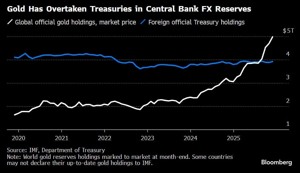
Image source: Bloomberg
Has gold overtaken the dollar?
No, not as a reserve currency.
The dollar remains the world’s most important reserve currency and continues to play a dominant role in the international financial system. However, gold has overtaken U.S. Treasuries as a single reserve asset within central banks’ total reserves.
This is an important distinction.
A reserve currency is, for example, the dollar, the euro or the yen. A reserve asset, on the other hand, can include government bonds, currencies or gold. So when several media outlets now report that gold has overtaken U.S. bonds, it does not mean that gold has replaced the dollar as a currency. It means that gold has become larger than U.S. Treasuries in central bank reserves.
Why has gold’s share increased so much?
There are two main explanations.
The first is that central banks have continued to buy gold on a large scale. According to the ECB, central banks bought around 850 tonnes of gold in 2025. This is lower than the more than 1,000 tonnes per year purchased between 2022 and 2024, but still very high by historical standards.
The second explanation is the price development. The ECB highlights that the sharp rise in the gold price has played a major role in increasing gold’s share of reserves. In nominal terms, the gold price rose by around 60 percent in 2025 and 30 percent in 2024, which automatically increased the value of the gold reserves that central banks already held.
In other words, central banks have both bought more gold and seen the value of their existing gold reserves rise sharply.
A clear signal from central banks
Gold regaining a larger role in central bank reserves is no coincidence. It reflects a world in which many countries want to reduce their dependence on individual currencies, spread their risks and strengthen the long-term resilience of their reserves.
The ECB states that central banks hold gold both for diversification and as protection against geopolitical risk. Countries such as China, Poland, Turkey and India have been among the larger buyers since 2022.
This makes the development particularly interesting. Gold does not pay interest, requires storage and can fluctuate in price. Yet many central banks still choose to increase their exposure.
Why?
Because gold has one quality that few other assets have: it is not someone else’s liability.
A government bond is based on a promise from a state. A currency is based on trust in a country’s economy and central bank. Gold, however, stands outside that system. It is a physical asset with global acceptance and thousands of years of historical significance.
Tavex was already on the same track in 2025
In October 2025, Tavex published the article “Can gold overtake the dollar in global reserves?”. The article raised the question of gold’s growing role in central bank reserves and what it would take for gold to move closer to the dollar’s dominance. The Tavex article was published on 29 October 2025.
The latest reporting shows that developments have moved in the same direction as the question suggested.
Gold has not yet overtaken the dollar as a reserve currency. But gold has now surpassed U.S. Treasuries as a reserve asset. This is a clear signal that central banks’ view of security, diversification and long-term value is changing.
What does this mean for savers?
For private individuals, this does not mean that they should think exactly like a central bank. Central banks have different objectives, larger balance sheets and different risks than ordinary savers.
But there is still an interesting parallel.
When central banks choose to hold gold, they often do so to create balance, reduce dependence on individual currencies and protect themselves against uncertainty. This is the same basic idea many private investors have when they choose to own physical gold as part of their long-term savings.
Gold is often used as:
- a complement to equities and funds
- protection against currency depreciation
- a physical asset outside the banking system
- a long-term store of value in uncertain times
This does not mean that gold always rises in price. But it does show why gold continues to play an important role, both for central banks and private savers.
Take the opportunity to buy this gold bar today at a good price!

Has the dollar lost its role?
Not yet.
The dollar remains the dominant currency in global trade, financial markets and central bank currency reserves. The ECB’s report also shows that the dollar still holds a very strong position in global foreign exchange markets, where it is involved in almost 90 percent of total trading in foreign exchange and OTC derivatives.
What has changed, however, is how central banks view what they want to hold alongside the dollar.
For a long time, U.S. Treasuries were the obvious safe asset. Now gold has taken on a larger role.
Gold’s return is hard to ignore
The fact that gold now accounts for 27 percent of global official reserves shows how quickly its role has strengthened. After long being viewed as a safe but passive asset, gold has once again become an important part of central banks’ financial preparedness.
At the same time, it is worth remembering that the ECB also emphasises that gold’s increased share is largely due to the rise in price. If valuation effects are adjusted for, using the gold price from the end of 2023, U.S. Treasuries are still larger than gold as a reserve asset.
This makes the development less dramatic than some headlines suggest, but no less important.
Because when the world’s central banks continue to hold, buy and value gold highly, it says something about gold’s role at a time when trust, stability and independence have become increasingly important.
Would you like to buy or sell gold yourself? You are warmly welcome to visit Tavex in one of our stores in Stockholm, Gothenburg or Malmö. You can also buy investment gold directly online at tavex.se.
Gold price (XAU-SEK)
41068,40 SEK/oz
- 511,90 SEK
Silver price (XAG-SEK)
597,10 SEK/oz
- 15,91 SEK
Recommended articles


You might also like to read


Contact
Tavex AB Reg.nr.: 556671-1189 Smålandsgatan 9, 111 46 Stockholm, Sweden
E-mail: tavex@tavex.se
Tel. 08-678 20 30
Comments